production
Agentic data organisation with Claude
In one line: Claude coordinates agent roles (analytics, platform, governance) — not a human org chart — so data delivery has clear ownership and quality gates.
Context
Classic data teams collapse analytics, platform, and governance onto the same people. I wanted an operating model that could run faster without losing traceability.
Why it was worth building
Without explicit roles, agent-assisted data work becomes a single chat thread with no accountability. Naming agent roles makes handoffs and gates testable.
What I built
Coordination layer
- Claude — prioritisation, cross-team summary, risk assessment (coordinator, not “Head of” people).
Agent roles (specialist workers, not employees)
- Analytics lead agents — KPI ownership, insight generation, dashboard agents.
- Platform lead agents — pipeline engineering, infrastructure reliability.
- Governance lead agents — quality, policy, compliance checks.
Daily loop — signal collection → leadership summary → task distribution per lead → quality gates → memory feedback. High-risk paths escalate to governance agents before release.
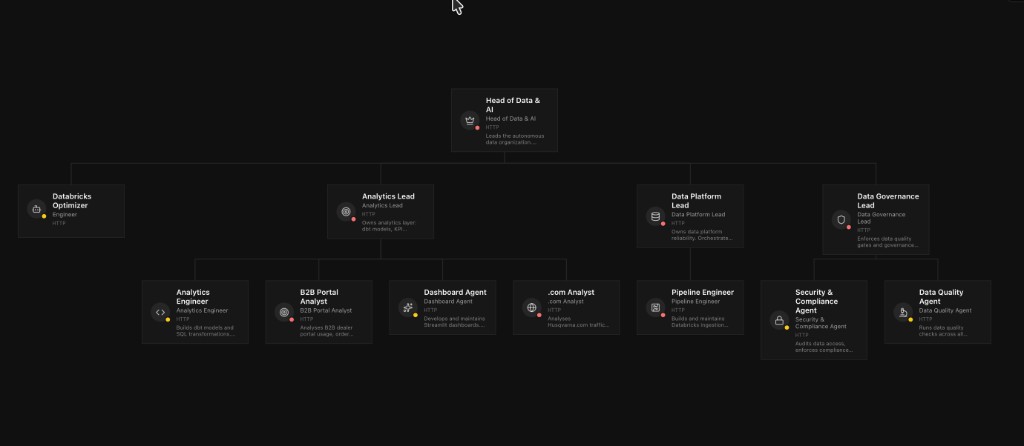
This project page is the canonical case (the former blog post redirects here).
How it was adopted
Used as the reference model for agentic data delivery on this site and related platform work — always with human goals and approval outside the agents.
Effect
Clearer ownership map for agent-assisted analytics and platform tasks; faster decision cycles than undifferentiated “ask the model” workflows.
Where AI fits now
This is the agents on data complement to governed lakehouses: MCP-scoped tools, evals, and enterprise platform boundaries. Coordination moved toward GitHub + Cursor Automations for this repo, but role-scoped agents and gates remain the durable idea.
Want to compare notes?
I am always interested in thoughtful conversations about the decisions, trade-offs, and systems behind this work.
Get in touch